
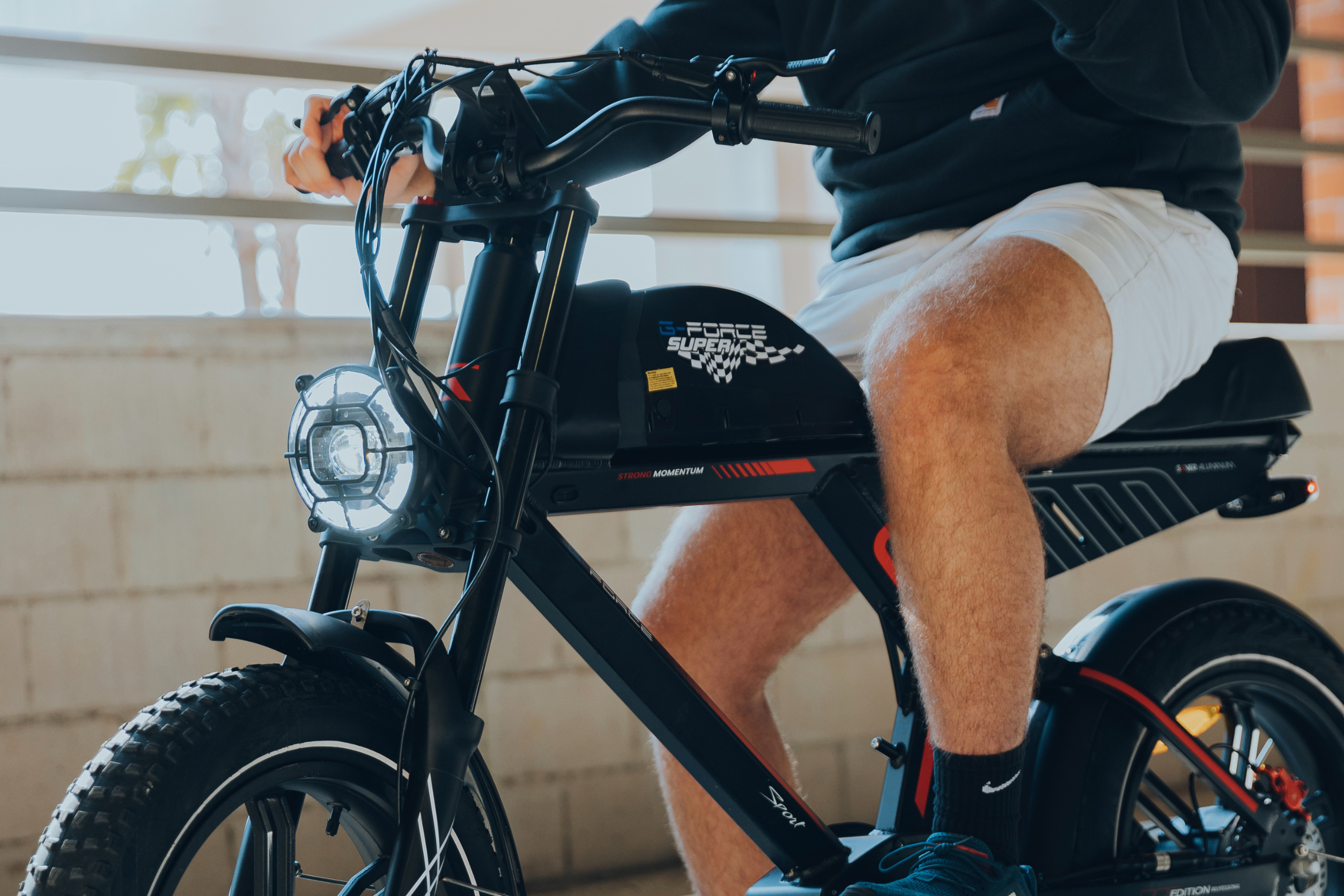
Walk down almost any street in Edmonds or Bothell right now and you’ll likely see one: a commuter gliding past on an e-bike, a teenager on a throttle bike doing 28 in a 25 like they’ve got somewhere to be, a weekend rider cruising the waterfront without a helmet in sight. No plates. No insurance card.
For most riders, that’s the whole appeal: an e-bike feels like a bicycle that skipped leg day, not a vehicle that needs a policy.
That instinct can hold up — legally speaking, a compliant e-bike really is just a bicycle, despite what growing debate over helmet requirements, speed caps, and shared-path safety might suggest. But a growing share of what’s actually on the road doesn’t clear that bar anymore, and Washington just made the line between “bicycle” and “motor vehicle” a lot easier to cross without realizing it.
Washington’s Three E-Bike Classes, and Why They Exist
Every legal e-bike in Washington falls into one of three classes. The differences aren’t cosmetic; they’re what keeps a bike classified as a bicycle instead of a motor vehicle.
- Class 1 assists only while you’re pedaling and stops helping at 20 mph.
- Class 2 adds a throttle that can move the bike with no pedaling at all, also capped at 20 mph.
- Class 3 pedal-assists up to 28 mph, requires the rider to be at least 16, requires an active speedometer, and is generally banned from shared-use paths unless the local jurisdiction has specifically opened them up.
All three classes are capped at a 750-watt motor and have to offer fully functional pedals — take away either of those and the classification stops applying.
As long as an e-bike stays inside these lines, Washington treats it like a bicycle: no license, no registration, and no insurance requirement, for any of the three classes.
When an E-Bike Stops Being an E-Bike
Here’s where it gets interesting for anyone shopping for an e-bike right now — or for those who purchased one for a child without giving it too much thought.
Washington’s e-bike definition has always rested on three requirements: fully working pedals (foot pegs don’t count), a motor capped at 750 watts, and motor assistance that cuts off at the class limit — 20 mph for Class 1 and 2, 28 mph for Class 3. Miss any one of those and your bike was never a legal e-bike to begin with.
What changed, as of June 11, 2026, is that Washington closed the loophole riders were using around it. Senate Bill 6110 now explicitly excludes any device capable of exceeding 20 mph on throttle power alone (no pedaling required), along with bikes built to be easily reconfigured past their class limits. Trip either of these two tests, and your bike legally becomes an electric motorcycle, full stop. Because Class 3 only reaches a 28 mph speed when the rider is actually pedaling, the new law doesn’t touch Class 3’s higher ceiling.
The reclassification isn’t a technicality. It puts the vehicle under an entirely different set of rules: registration, a license plate, required equipment, and — because it now falls under the state’s motorcycle laws — not just a standard driver’s license, but a motorcycle endorsement on top of it. Ride one without that endorsement and you’re not looking at a warning; local departments have been treating it the same as riding an unlicensed motorcycle.
The clearest example is also the most overlooked one: pedal-less, dirt-bike-styled electric bikes, specifically marketed to teenagers. No pedals at all means it fails the test automatically, no matter how slow it goes, which is exactly why several Puget Sound-area police departments have started calling this category out by name. But the quieter version is a “commuter” or cargo e-bike that’s throttle-heavy enough to keep pulling past 20 mph without any pedaling at all. Either way, the bike doesn’t announce its own reclassification. Riders tend to find out from a citation, an impound, or a claim denial — rarely before.
Washington’s Traffic Safety Commission built an interactive E-Ride Guide specifically designed to help riders sort this out before any of those things happen, and it’s worth five minutes for anyone who bought a bike without checking the label on the frame.
What Your Homeowners Policy Won’t Tell You
Even a fully compliant Class 1–3 e-bike — the kind Washington doesn’t require insurance for — isn’t automatically covered by the policies most owners assume are backing it up.
Homeowners and renters policies generally treat anything with a motor as a motorized vehicle, and that classification typically pulls e-bikes out of standard personal property coverage. Where a sublimit does exist for motorized recreational items, it’s frequently a fraction of what a modern e-bike actually costs — a real problem when a well-equipped commuter or cargo model can run well past what that sublimit was ever built to pay out.
And liability works the same way: if you or a loved one causes an accident while riding, the same motorized-vehicle exclusion that keeps your homeowners policy from paying for the bike often keeps it from covering the claim against you, too.
None of this is meant to talk anyone out of an e-bike purchase — this is a great region to own one in. It’s a reminder that “no requirement” and “no risk” aren’t the same sentence. The Bothell Police Department’s own e-bike guidance lays out the class system and the helmet rule plainly, which is useful — but it’s also a good example of how the public conversation tends to stop exactly at “no insurance required,” without ever getting to “so what happens if something goes wrong.”
Snoqualmie and North Bend have gone a step further, publishing their own guidance specifically on telling a legal e-bike apart from an illegal e-motorcycle — a sign this is turning into a regional, even national, enforcement priority.
“Not Required” Isn’t the Same as “Not Liable”
This is the part that trips people up most, because it sounds like good news until you think it through: Washington choosing not to require e-bike insurance is a licensing decision, not a liability shield. If you cause an accident — clip a pedestrian in a crosswalk, T-bone another rider on a shared path, force a driver to swerve — you’re personally on the hook for the medical bills, the property damage, and whatever a court decides you owe, exactly as if you’d done the same thing behind the wheel of an uninsured car.
The difference is that a car accident usually has a policy standing behind it somewhere. An e-bike accident often doesn’t.
Riders typically carry no dedicated liability coverage for the bike itself, so an injured party’s realistic options are the rider’s homeowners or renters policy — assuming it doesn’t carve out anything with a motor — or the rider personally. When neither holds up, what’s left is the rider’s own assets, savings, and future wages, because there’s no dedicated insurer standing behind the bike to collect from instead.
Generally speaking, riders should be less concerned with whether their e-bike might get stolen and more concerned about what happens to their finances if they’re the one found at fault. A judgment doesn’t check whether the vehicle that caused the damage needed a license plate.
Two Conversations, One Phone Call
Two very different conversations, and it’s worth knowing which one applies to you. If your bike stays inside its class limits — pedals working, motor capped, throttle behaving — you’re not required to insure it, but it’s still a great opportunity to find out whether your homeowners or renters policy would pay out if it were stolen off your porch or if you clipped a pedestrian. Often, the honest answer is no.
If your bike fails any part of the three-part class test — no pedals, too much wattage, or a throttle that can push it past 20 mph on its own — the conversation is no longer optional. That’s an electric motorcycle conversation: a motorcycle endorsement, registration, a plate, and liability coverage sized for a vehicle that can genuinely hurt someone at speed.
Either way, it’s not something to sort out after a claim. You likely don’t know whether your own homeowners, renters, or umbrella policy would actually respond to an e-bike claim — only the fine print in front of you answers that, and most people never think to check it until they’re holding a denial letter. That’s the value of working with an independent agent: we’ll pull that language, tell you plainly which category each rider’s bike actually falls into, and lay out what your current policies would (or wouldn’t) pay for if something went wrong.
A household with a teenager on a throttle-heavy commuter? Or a parent enjoying a compliant Class 1? It’s easy to assume both are handled the same way when neither has actually been checked. At Mark Weedin Insurance, we’ll walk through every rider and every bike in your household, not just the one that prompted the question, and put together the coverage that actually protects your family — standalone coverage, a full motorcycle policy, an umbrella endorsement, or a combination of these — instead of leaving the rest to assumption.
Let’s find out what your policy actually covers — for every rider in the driveway, before a claim decides for you.